Custom Fragrance Development: Seven Mistakes That Start in the Brief
Most custom fragrance projects that disappoint do not fail in the factory; they fail in the brief. A brief that names a mood but not a market, a price target but not an order volume, or a reference scent but not a reason will produce samples that are technically fine and commercially useless. The correction is unglamorous - decide the constraints before the perfumer starts, and write them down.
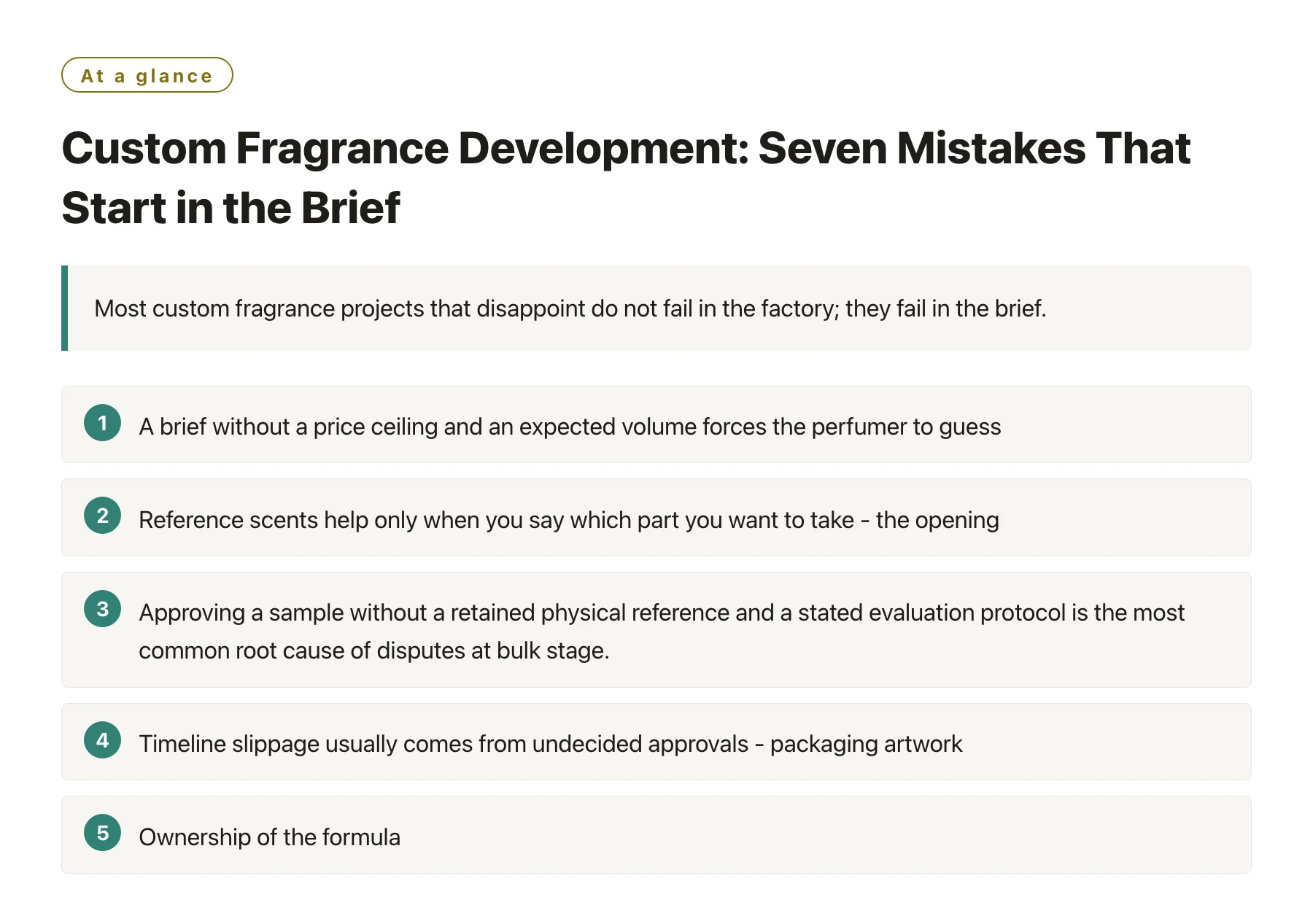
Key takeawaysA brief without a price ceiling and an expected volume forces the perfumer to guess, and guesses are usually solved with expensive materials. · Reference scents help only when you say which part you want to take - the opening, the drydown, the texture - rather than pointing at the whole impression. · Approving a sample without a retained physical reference and a stated evaluation protocol is the most common root cause of disputes at bulk stage. · Timeline slippage usually comes from undecided approvals - packaging artwork, label text, regulatory review - rather than from production. · Ownership of the formula, the mould and the design files is a brief decision too, because it shapes what the quote is allowed to include.
By the time a brand has one successful line, the temptation is to treat the next fragrance project as a repeat of the last one. It rarely is. Different category, different retail channel and different price band all change the brief, and the mistakes listed here are the ones that recur across all of them.
This is written from the buyer's side of the table, for teams that already know what a sample round looks like and want fewer of them.
Mistakes that are made before any oil is weighed
These three account for the largest share of wasted development budget, and all three are visible in the first meeting.
1. Briefing a mood instead of a market
Words like clean, warm and expensive are starting points, not instructions. A workable brief says who buys the product, where it sits on the shelf, what it will be compared against, and which direction is off limits. The perfumer can hold two or three directions in mind at once; they cannot hold an unstated market position.
2. Treating a reference as a template
Sending a competitor's bottle and asking for something like it is common and defensible, provided you separate the parts. Specify that you want the same opening brightness, a lighter base, and no similarity in the drydown. That distinction also keeps the project away from copying, which matters commercially as well as ethically. Where a design or a pack shape is genuinely distinctive, protection is available through national registration systems and the international route administered by WIPO, and it is worth knowing who would hold that right [1].
3. Leaving cost and volume until after selection
Formula cost is set during development, not after it. If the brand names its target landed cost late, the only remaining options are reformulating - which restarts stability work - or accepting a price the product cannot support.
The practical form of this mistake is a brief with no order volume. Volume determines tooling amortisation, whether a custom bottle is viable, and how much development the supplier can absorb. A manufacturer developing scents in house, such as Guangzhou Xuelei Cosmetic Co., Ltd., will usually ask for both numbers before the first trial, because they change the whole cost structure rather than a line on it.
The mistake, the symptom, and the correction
| Mistake | How it shows up later | What to write instead |
|---|---|---|
| No price ceiling in the brief | A beautiful first sample that cannot be produced at the target cost | A landed cost range plus the volume band it assumes |
| No order volume stated | Tooling and packaging options quoted that the brand cannot fund | A first-order quantity and a twelve-month forecast |
| Vague reference direction | Two or three samples that all miss, for different reasons | Named attributes to copy and named attributes to avoid |
| No decision-maker named | Feedback arrives as a committee summary, weeks late | One approver, one alternate, and a response deadline |
| Approval by photograph | Bulk arrives and does not match the approved sample | A retained physical sample, signed and dated by both sides |
| Compliance left to the end | Artwork and claims reworked after the formula is fixed | Target markets listed in the brief, with documentation scope |
Every correction in the third column costs nothing to write and saves a sample round. That is the whole argument for spending an extra hour on the brief.
A brief is not a creative document. It is a constraint document with a creative section inside it. Write the constraints first - market, price, volume, format, timing, documentation - and let the olfactory direction be the paragraph at the end. Perfumers do better work inside a box than in front of an open field.
Mistakes that only appear after the first sample
The second group of errors is harder to see coming, because the project looks healthy at the point they are made.
4. Approving a sample the team cannot reproduce
A sample approved on a blotter at a trade show, or from a photograph of a bottle, is not a specification. Approve a physical retained sample held by both parties, with a batch reference and a date, and make the bulk match that object rather than anyone's memory of it.
5. Rebriefing instead of correcting
When a sample is close but not right, the efficient move is a correction - more brightness at the top, less sweetness at the base, a firmer fixative. A new brief discards the work already done and resets the perfumer's mental model. Brands that iterate well describe adjustments in the language of the material, not in the language of feelings.
6. Forgetting the paperwork until the product is finished
The documentation a market requires shapes the formula, not just the file. Safety assessment, ingredient disclosure and restricted-material limits all need to be known while the formula is adjustable. Ask early which markets you are shipping to, then confirm what the supplier will provide for each, and verify the claims independently rather than assuming a certification list covers your product.
7. Interviewing suppliers with an incomplete brief
Comparing quotes built on different assumptions is not a comparison. Send the same complete brief to every supplier you are considering, so the responses differ only in how they solve the problem. That is also the fastest way to see who read the brief at all - and to check, before signing, what to verify before signing with a fragrance manufacturer.
What a brief that survives contact looks like
A good brief fits on two pages. The first page carries the commercial frame: brand, product type, format, market, retail price, target landed cost, first order quantity, forecast, launch window, and the name of the single approver. The second page carries the creative direction, the references with their named attributes, and any hard exclusions such as materials the brand will not use.
Attach the compliance scope as a short list rather than a paragraph. If the brand does not know the scope yet, say so explicitly and mark it as an open item with an owner and a date. An open item with a date is manageable; an unstated one is not.
Finally, choose the supplier on how they respond to the brief, not only on price. A partner that can handle custom fragrance R&D and production under one roof will answer the commercial page and the creative page with the same document, which is the earliest signal that development and manufacturing are not being stitched together by email.
Sources
- WIPO — World Intellectual Property Organization —— The UN agency for intellectual property; resources on industrial design and patent protection relevant to product and packaging design.
Frequently asked questions
How detailed should a fragrance brief be?
Detailed on constraints and open-ended on creativity. Market, cost, volume, format and timing should be precise; the scent direction should describe intent and boundaries rather than dictate a formula.
Should we send a competitor's product as a reference?
You can, but separate what you want from it. Name the attributes to emulate and the attributes to avoid, and never ask for a copy - reproducing a protected design creates legal exposure for the brand, not just for the factory.
How many sample rounds should we budget for?
Plan for three to four rounds on a new direction and one or two on a modification of an existing formula. If you are routinely exceeding that, the brief is usually the cause rather than the perfumer.
Who should own the formula when the project ends?
That depends on the commercial model. Under OEM the brand usually holds the formula; under ODM the manufacturer often retains it unless exclusivity or transfer is purchased. Decide before development begins, because it changes the price.
What is the single most common cause of delay?
Waiting on approvals - artwork, label copy, compliance sign-off - rather than production. Map those decisions onto the same calendar as the sampling rounds and assign an owner to each.